
Criminal Court Cases in Marshall County
Felonies, misdemeanors, traffic cases, and ordinance matters are filed in the Marshall County Circuit Court, part of Illinois's Tenth Judicial Circuit. Marshall County has one courtroom handling all case types. The elected Circuit Clerk, not the County Clerk and Recorder, opens the case, assigns its number, records appearances and hearings, and keeps orders, judgments, assessments, and sentencing entries.
The courthouse is at 122 North Prairie Street in Lacon. Public counter hours listed by Illinois Courts are 8:30 a.m. to noon and 1:00 to 4:30 p.m. The Circuit Clerk can be reached at 309-246-6435. A call before travel helps confirm whether an older Marshall County file must be retrieved and whether the needed document can be copied or certified.
What the Marshall County Circuit Clerk Keeps
The Circuit Clerk's official directory page links to online court records, e-filing, payments, and the office contact. Its criminal file begins when the State's Attorney files or pursues a complaint or information, or when a felony proceeds by indictment. The docket then collects appearances, hearing entries, motions, orders, pleas, dispositions, and sentence information.
The State's Attorney reviews a police referral and determines which allegations to file, but that office is not the public custodian of the complete court file. The sheriff keeps its own incident or arrest record. This division explains why a Marshall County arrest label may differ from the filed counts and why the court judgment is the proper place to confirm the eventual outcome.
The county source shows the clerk's record-access role before the view below.
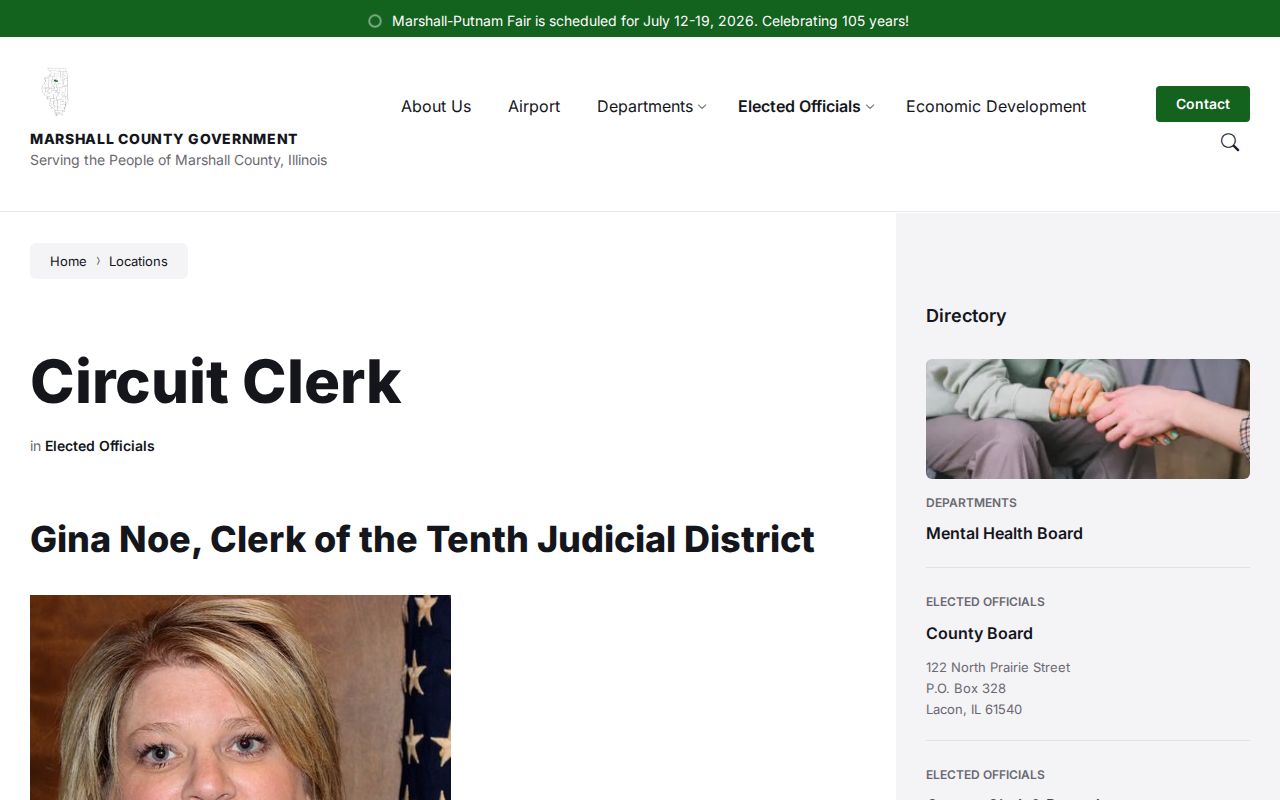
The clerk page provides the local route from an online index entry to a copy, archived file, or certified disposition.
Marshall County Case Record Searches
The county-selected online channel is Judici with Marshall County selected. Basic docket access is free, while some document or premium features may require payment or a subscription. Coverage and features vary among participating counties, so begin from the Marshall-specific link rather than a general search page.
- Confirm that Marshall County is the selected court context.
- Choose a name search or enter the full clerk-assigned case number.
- Use first and middle names to narrow a common surname when those fields appear.
- Open the matching docket and read the charge, count, status, event, and disposition entries together.
- Give the case number to the Circuit Clerk when requesting a document, archive search, plain copy, or certified disposition.
| Field | Type | Required | Use |
|---|---|---|---|
| Court | Selected context | Yes | Keep Marshall County selected |
| Search By | Tab or option | Yes | Choose name or case number |
| Last Name | Text | Name search | Spelling and aliases matter |
| First/Middle Name | Text | Optional | Narrows similar names |
| Case Number | Text | Case search | Use the full format |
| Search or Reset | Button | As needed | Run or clear the query |
The Marshall County Judici form is shown below without displaying a person's results.
The county selection and identifiers on this form help reduce false matches, but the online result is still an index rather than a certified court record.
When an Older Marshall County Case Is Offline
A missing online result does not establish that no case exists. An older file may require an archive or microfilm search, while a sealed or expunged matter may be absent from ordinary public access. Contact the Circuit Clerk with the approximate year, the name used at filing, the suspected charge, and any known case number. Ask whether staff must retrieve the file and whether the requested item is public.
For formal proof of the result, ask specifically for a certified disposition. A screenshot does not carry the clerk's certification and can omit the document that explains a later change. Plain-copy, certified-copy, and search fees were not confirmed in the research, so request the current schedule from the clerk instead of relying on an old amount.
What a Criminal Case File Contains
A Marshall County case file ties a charge to a chronological court record. The useful fields are read together, because a caption or first charging entry alone does not state the final result. One case can contain several counts with different outcomes.
| Case number and court | Marshall County identifier, filing date, case category, and status |
|---|---|
| Parties and appearances | Public party role, name, and attorney appearance where available |
| Charging document | Complaint, information, or indictment and each alleged statute or class |
| Docket entries | Filings, appearances, hearings, pleas, orders, and warrant activity when public |
| Disposition | Outcome by count, including dismissal, acquittal, or conviction |
| Judgment and sentence | Custody, probation, conditional discharge, assessments, restitution, and conditions |
Note: A dismissal on one count does not establish the outcome of every other count in the same Marshall County case.
Reading CF, CM, and Outcomes in Marshall County
Illinois case categories help organize the docket. A CF entry generally identifies a felony criminal case, while CM is used for a misdemeanor criminal case. Traffic and ordinance matters can also appear in the circuit structure. The category is a filing label, not proof of guilt, and the precise statute and class belong to the count entry.
Disposition language carries more weight than the initial label. A dismissal ends a charge without a guilty judgment. An acquittal is a not-guilty result after trial. A conviction follows a guilty plea or finding of guilt. Nolle prosequi records the prosecution's formal choice not to proceed, subject to the law and the court's action. Read the final entry for each count and obtain the order if the summary is unclear.
Criminal Case Stages in Marshall County
Police create the arrest or summons material, then the Marshall County State's Attorney decides what to file. Once the clerk opens a case, the public court trail can include probable-cause action, arraignment, pretrial litigation, plea or trial, final disposition, and sentence. Post-judgment motions, appeals, compliance proceedings, warrants, sealing, or expungement can later change the visible history.
Case flow: Charges Filed › Arraignment › Pretrial › Plea or Trial › Disposition › Sentencing
This sequence is a reading aid, not a promise that each Marshall County case uses the same number of hearings. The docket date for a future setting shows what is scheduled, not what the judge will decide.
One Marshall County Courtroom, Several Record Types
The Illinois Courts courthouse profile identifies one courtroom for all case types, plus public e-filing, self-help, and law-library stations in the courtroom area and first-floor hall. That compact arrangement does not merge the court file with sheriff reports, probation working files, or County Clerk land and vital records.
The courthouse details source supplies the public-access context shown here.
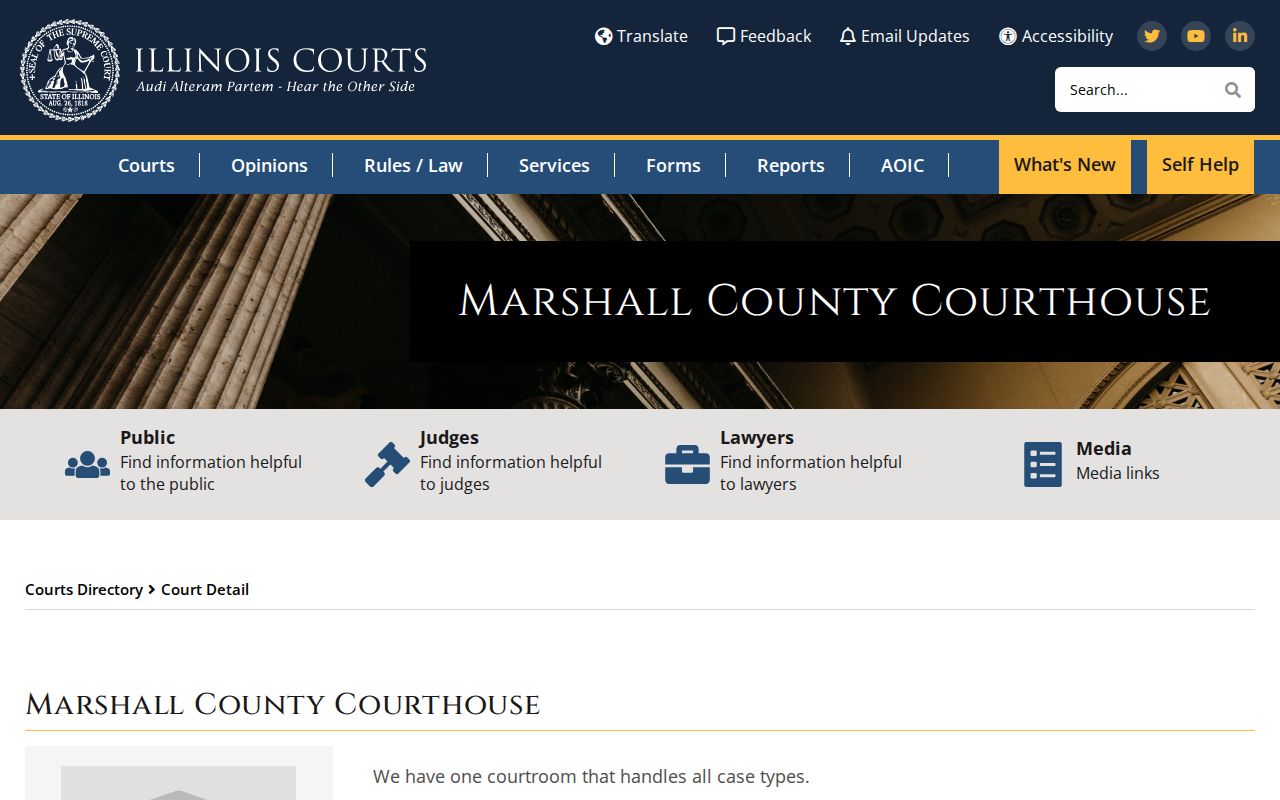
The profile helps plan a counter visit and locate public stations, while the Circuit Clerk remains the office to ask for Marshall County criminal case copies.
Choosing the Right Illinois Court Directory Entry
The Illinois Courts directory helps verify the Tenth Judicial Circuit and the current appellate assignment. It is useful for court location and administration, but it does not replace Judici or the clerk's file. Federal cases serving Marshall County are separate and belong to the U.S. District Court for the Central District of Illinois, not the Marshall County Circuit Court.
The state court directory interface appears below.
Use the directory to verify the court, then return to the Marshall County case channel for docket details and copies.
Access Rules for Case Records
Illinois court files follow judiciary access and redaction rules rather than treating the Circuit Clerk as an ordinary executive-agency FOIA database. Juvenile matters, sealed or expunged cases, protected victim information, personal identifiers, and security-sensitive material may be restricted or redacted. An online view may also expose less than the courthouse file.
Sheriff-created reports use the Illinois Freedom of Information Act, while filed Marshall County cases and certified dispositions come from the Circuit Clerk under court-access rules. Statewide conviction information is a separate ISP product. Keeping those channels distinct prevents a police allegation, a public docket, and a compiled repository response from being mistaken for the same record.
Expungement and sealing can change ordinary public visibility under 20 ILCS 2630/5.2. Expungement generally removes qualifying arrest-record material, while sealing restricts public access but preserves access authorized by statute. A matter that once appeared in Judici may therefore stop appearing after an order. The Circuit Clerk cannot disclose a restricted file merely because a searcher remembers the case.
Language and disability access should be arranged before a Marshall County court date or records visit. Illinois Courts provides interpreter resources, and the courthouse profile identifies the local accessibility contact. Court interpretation supports proceedings; it is not an on-demand translation service for an entire file. Call the clerk in advance to explain the access need and confirm the proper process.